

Page to be completed summer 2026
The Arctic winter is perceived as a long, dark and cold period. The figure below is the sun diagram for Longyearbyen (78º) and indicates the timing of the midnight sun, polar night and twilight.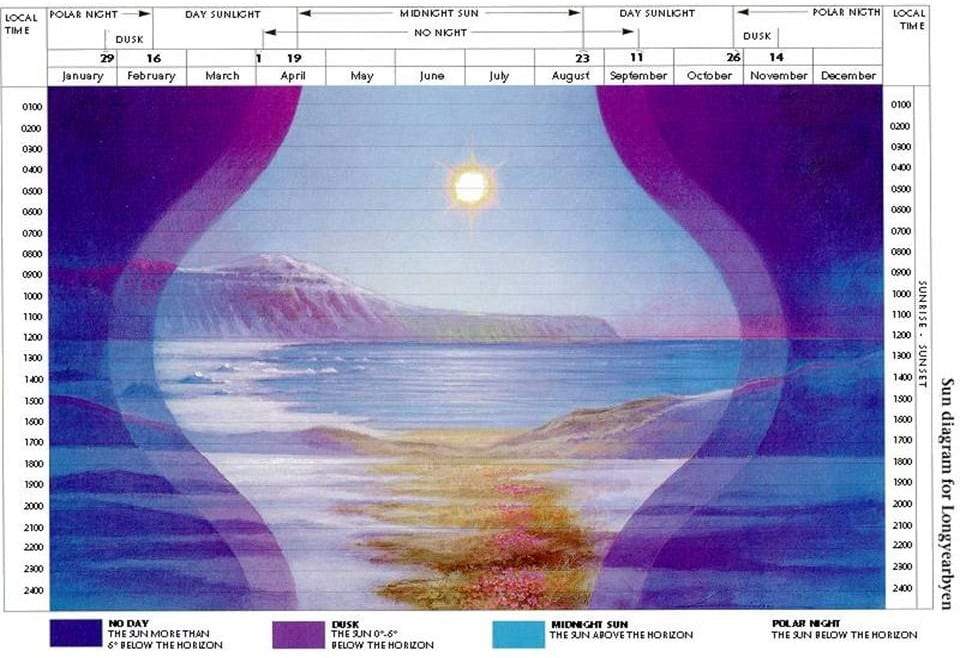 The durations of the photoperiods are not changing which are determined by the Earth’s orbit. However, winter temperatures are changing rapidly. Mean monthly temperatures are rising and there is an increased frequency of mild weather events with air temperatures above 0ºC with, or without, accompanying rain.
The Arctic is characterised by permafrost. The upper 1 to 2 m of the ground is termed the ‘active layer’ and it is this layer melts each summer and freezes each autumn and winter. This means that in the winter the ground is frozen and impermeable. Should there be a rain period, termed a rain-on-snow event, or warm spell enabling melt of the snow pack, the liquid water percolates to the ground surface where it is trapped and freezes as a surface ice layer. This layer can be many tens of cm thick. The images here provide a graphic example of how this ice can develop.
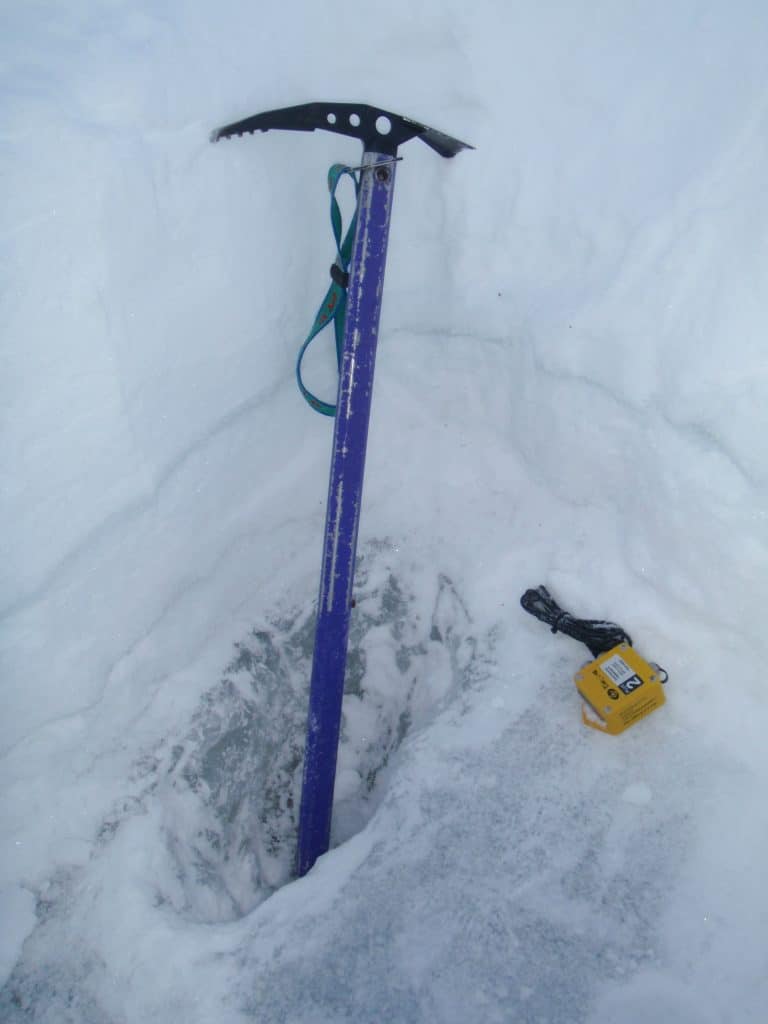
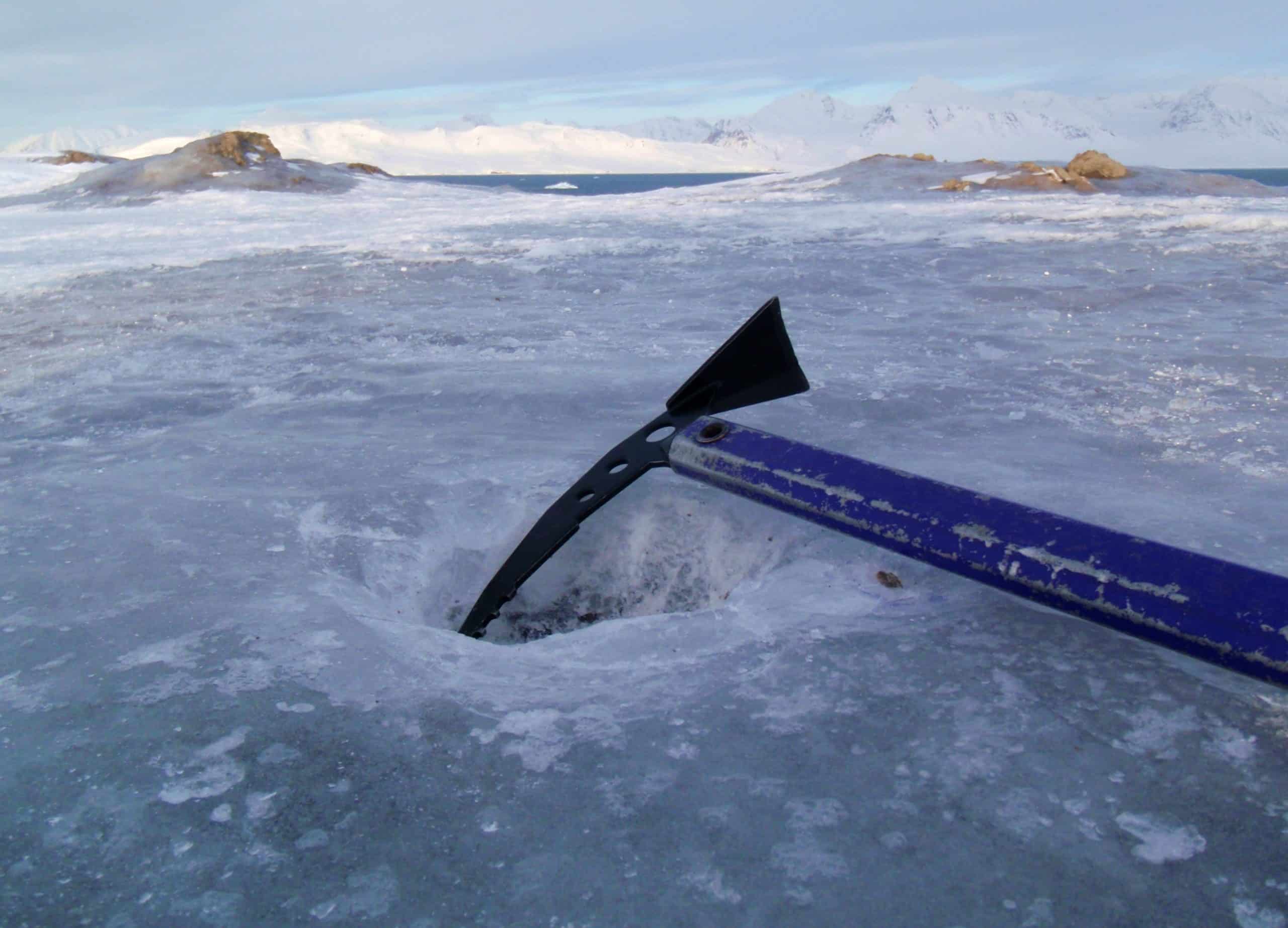
There have been extremely few studies to determine the effects of these icing effects on the overwintering soil fauna. This fauna is recognised to be tightly connected and involved in the Arctic ecosystem observed during the thawed summer season, but the composition of this community is dependent on surviving the 8 to 9 months of the frozen winter period. How these icing events will impact the overwintering survival, and hence the summer community, is unknown. A paper from 2000 (Coulson et al. 2000) indicated that these icing events may increase overwintering mortality of the springtails but had less impact on the mites.
This is the starting point for a series of overwintering field experiments with the UNIS course AB-329 Arctic Winter Ecology. In this course the students expose soil cores containing the natural soil springtail and mite communities to a winter season during which they manipulate surface ice thickness, duration of ice, snow depth, and a combination of the above. The experiments are established in October and samples recovered after thawing in May. The students then examine the effect of the various treatments on the overwintering survival of these animals and determine the effect of surface ice on survival.
The first projects focussed on the effect of snow depth on survival, the expectation being that survival of springtails and mites would be greater under a deep snow layer than where snow was absent since snow protects the soils against the extreme low air temperatures and the rapid changes in these temperatures.
However, the striking observation was that this is not the case. The predictions, based mainly on laboratory studies, were incorrect. This fauna is far more tolerant of extreme low temperatures and temperature cycles than was expected and survival was similar between soil cores that had either no snow and experience almost -30ºC and those from under >1m of snow and where temperatures were constant and rarely below -5ºC. These results were published with the students (Convey et al 2015) and a follow up paper in 2023 (Coulson et al. 2023).
In recent years the projects have focussed on the icing itself. The data from projects the past three successive winters are being worked up with a view to publication in the near future. Information and data will appear on this site when available. Watch this space !
The video clip below shows preparing to ice treatments on a blustery day in January.