

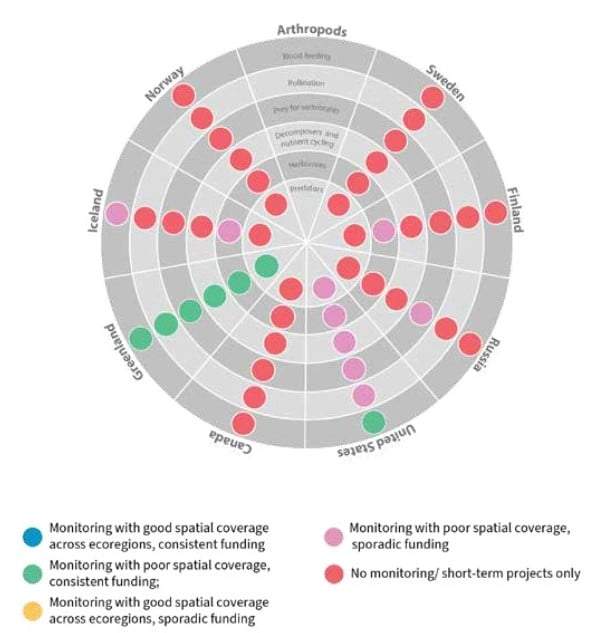
Invertebrates are an integral part of all terrestrial and freshwater ecosystems yet their ecology is poorly understood in the Arctic. In particular long term coordinated time series data are lacking from the Arctic with a couple of notable exceptions in Greenland, Greenland Ecosystem Monitoring (Fig 1). Svalbard provides a unique location for strengthening multidisciplinary knowledge of these organisms and understanding their role and resilience in a changing world. There are an increasing number of calls for comprehensive and coordinated time series data collection of these populations in the Arctic (e.g., Aronsson et al 2021, Coulson et al 2025, Gillespie and Høye 2026) but little action as yet.
Figure 1. Arthropod monitoring. Aronsson et al 2021 (Conservation of Arctic Flora and Fauna State of Arctic Terrestrial Biodiversity Report)
Text adapted from popular science section Coulson et al. 2025
Invertebrates are ubiquitous and comprise groups with enormous diversity of form and function. They play crucial roles in ecosystems, for instance serving as food for other organisms and as pollinators and decomposers. The known number of invertebrate species vastly outnumbers vascular plants, birds and mammals combined and the mass of just the springtails (Collembola) in Svalbard is in the order of 1,000’s of tonnes. But we have a disproportionately inferior knowledge of this part of biodiversity, due to challenges in identification, sampling, access, funding and functional understanding. This is especially unfortunate since annual characteristic annual swings in population sizes of these animals requires that long time series data are available in order to draw accurate conclusions.
Svalbard is one of the fastest changing environments globally, and with its established history of multidisciplinary environmental research, Svalbard provides a sentinel for studies for resilience and response to environmental change. We highlight the need for comprehensive biodiversity surveys across Svalbard in order to better inform governance actions aimed at protecting and preserving this unique environment.
We also highlight the key role that can be played by research on the Svalbard terrestrial and freshwater invertebrate community in understanding resilience and vulnerability to the consequences of environmental change. We further emphasize the importance of this research in upscaling from Svalbard to understand threats and consequences across the entire Arctic region.
In summary, while research on Arctic invertebrates in Svalbard has a long history and the current inventory is amongst the best available and quality-assured for any region of the Arctic, the Arctic generally, and many regions of Svalbard specifically, remain desperately understudied. To a large extent there is lack of coverage in terms of spatial and temporal patterns of biodiversity at all levels and in the application of integrated approaches linking trophic levels and energy and nutrient fluxes. Specifically, while lists of species recorded and described are available, the abundance, community age structure and functional significance of these species and populations are largely undocumented or unknown. Finally, there is a general lack of understanding of the sensitivity of most species to changes in climate, land use and other anthropogenic drivers, and the consequential cascading effects on linked biological systems.
Specific knowledge gaps include:
- Baseline documentation of the invertebrate biodiversity of Svalbard including temporal and spatial description of the distribution and abundance of this biodiversity (i.e. alpha, beta, gamma biodiversity) and a description of community structure and genetic variation in, and between, invertebrate populations. A comprehension of the great differences in species composition across relatively small geographic scales is lacking.
- Improved understanding is required of the origin and history of colonisation of invertebrate species and populations and the potential for genetic exchange with other populations across geographical scales. Monitoring of potential invasive alien species and their likely effects on native biodiversity is lacking (e.g. through direct competition, vectoring of disease, parasitism).
- Identification of taxa that respond to, or are vulnerable to, change and/or have possible range shifts. There is a clear lack of understanding of the local adaptation of species/populations and their resilience to climate change, changes in land use, pollution and other anthropogenic and biotic drivers. This includes the ability of species to adjust their physiologies or life histories sufficiently to enable them to show resilience to projected environmental change.
- The ecological roles of species and linkages across trophic levels, for instance nutrient cycling, pollination and seed production, population dynamics of birds, reindeer through parasitism and food, are very far from understood. These include links across the marine/terrestrial biospheres.
- Knowledge, dynamics and challenges from Svalbard need to be translated across other Arctic systems (and vice versa), allowing Svalbard to act as an early warning system, or sentinel, for wider global patterns and effects of change. The upscaling of data from Svalbard to other parts of the Arctic is largely unaddressed.
- Lack of any monitoring of IAS species or the potential threat that these species with the ability to be transported to Svalbard may represent to the native Svalbard flora and fauna communities. A risk assessment is currently lacking for Svalbard and the archipelago requires building fully into the current IAS risk assessment toolkits.
- A framework for how these data and conclusions can be used in management and policy frameworks requires developing.